

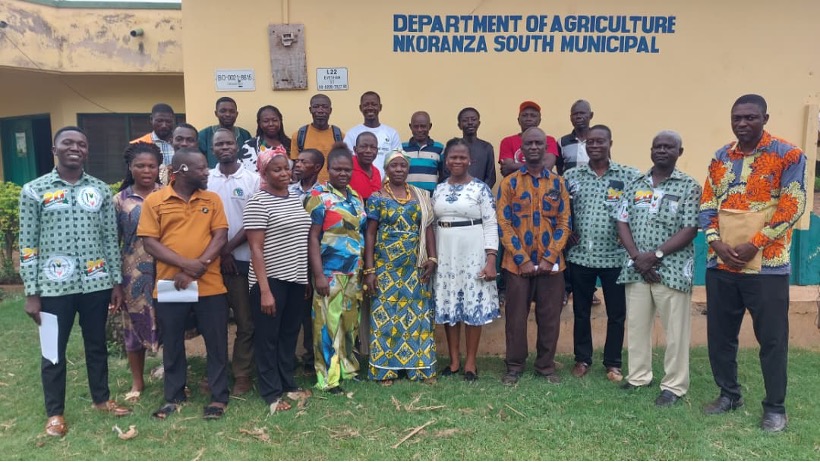
Date: Thursday, 28 May 2026
BACKGROUND
The Peasant Farmers Association of Ghana (PFAG), organized a one-day capacity building session for members of the Multi-Stakeholder Platform (MSP) in the Nkoranza South Municipal Assembly of the Bono East Region. The event formed part of the ongoing project on “Strengthening Farmers’ Voices to Promote Accountability and Inclusive Decision-Making in Ghana,” supported by the Star Ghana Foundation.
The MSP comprises representatives from the Nkoranza South Municipal Assembly, PFAG district executives, Civil Society Organisations, processors, aggregators, traditional authorities, and youth and women’s groups, and was strategically constituted as part of the project to engage duty bearers and rights holders, tackle bottlenecks affecting smallholder farmers and deepen inclusive governance and accountability.
SESSION HIGHLIGHTS
Safeguarding & Inclusive Engagement
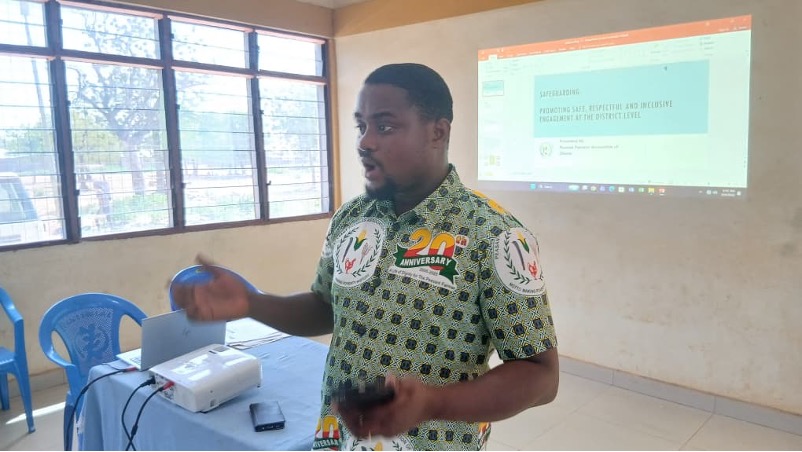
Dr. Roger Akanbisik led participants through principles of safe, respectful, and inclusive engagement, covering safeguarding concerns, stakeholder commitments, and reporting mechanisms. He stressed that all actors must protect children, vulnerable adults, and community members from abuse, exploitation, and discrimination. He urged members to ensure that any safeguarding concerns are addressed promptly, confidentially, and with dignity.
Municipal Composite Budget Analysis
Dr. Benjamin Sarfo, Programmes Officer of PFAG, unpacked the 2026 Nkoranza South Municipal Assembly composite budget.
The analysis revealed a stark structural gap, where Agriculture, which employs 65% of the district’s active population, received only 1.63% of the total budget, making it the third lowest funded sector, behind Infrastructure (44.0%), Social Services (37.6%), and Management & Administration (16.6%). Critically, 93% of the agricultural allocation goes to salaries, leaving just 7% for actual farm operations. Key priorities such as small-scale irrigation, livestock breed introduction, women farmers’ access to mechanization, and Good Agricultural Practices had no budget lines at all. Dr. Sarfo used these findings to anchor a strong advocacy agenda for the MSP going forward.
Advocacy for Accountability
Dr. Sarfo further equipped MSP members with advocacy tools and frameworks, emphasizing that effective advocacy messages must be clear, fact-based, solution-oriented, concise, and respectful. He called on the platform to leverage its collective voice to demand improved policy responsiveness, enhanced accountability in service delivery, and sustained constructive engagement with local governance structures.
The participants expressed satisfaction with the knowledge gained and indicated their resolve to work with each other to ensure that needs of farmers within the municipality are addressed. Rev. Paul Owusu Achiam, lead convenor for the MSP in Nkoranza South and a farmer indicated that “This is the first time I am learning how the composite budget was drafted and submitted, leaving Agriculture with only 1.63% of the total share. It is truly an eye-opener.” Madam Rose Yahaya, a queen mother of the Adoagyir traditional area also added that “I am shocked to see no budget lines for specific programmes for women and youth in the Municipality. PFAG’s presentations have been eye-opening, and we must act.“
Other stakeholders including the crop officer, Mr. Joshua Yaw Jeyija, indicated that “the kind of information shared here can serve as a powerful tool to advocate for what farmers in this Municipality demand and deserve. This platform must be sustained beyond the project lifespan“, while Dr. Gillian of
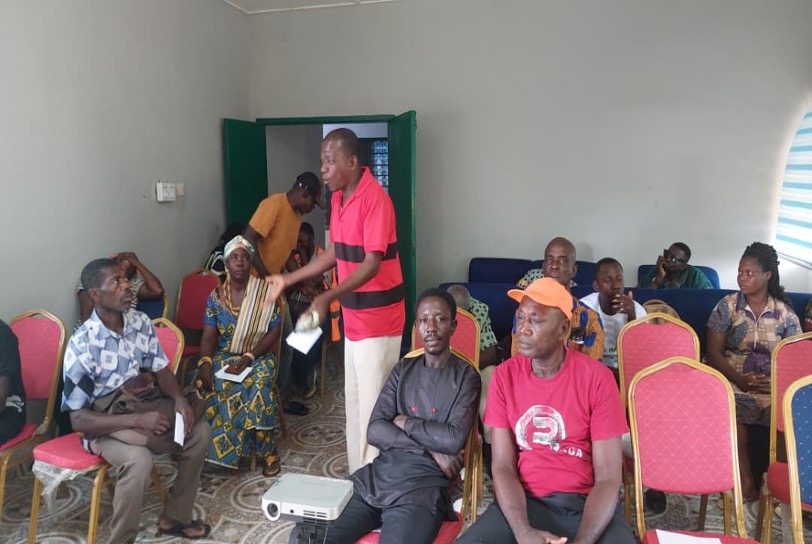
The National Commission for Civic Education (NCCE) added that “We will support the MSP in driving the inclusive agricultural growth we all aspire to achieve in this Municipality.”
NEXT STEPS
All participants pledged to track every cedi in the budget, using the PFAG scorecard and the provisions of the Right to Information Act, to ensure allocations are used for their intended purposes. Dr. Sarfo tasked MSP members to cascade insights from the training to community members at the grassroots level, deepening awareness and strengthening collective advocacy across the Municipality.